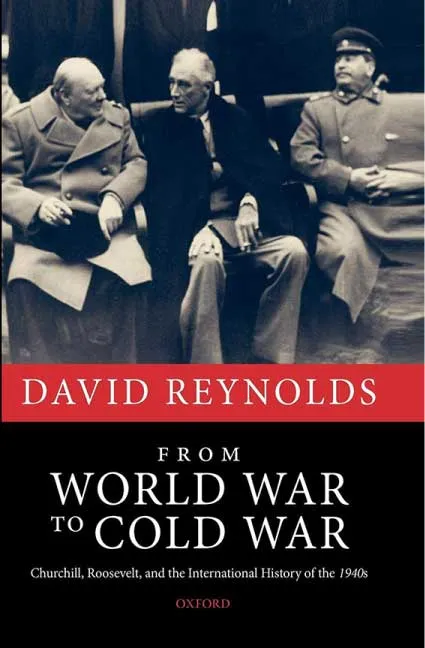
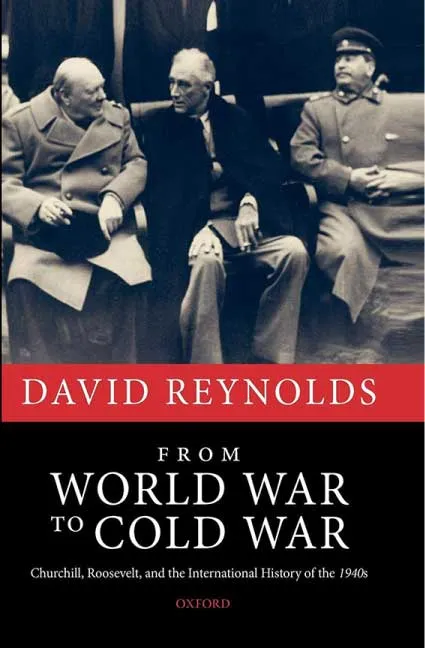
World War To Cold War by David Reynolds
0.00 ৳
0.00 ৳
David Reynolds’ "World War to Cold War: The Trusteeship of the West" (published in 2006) is a masterful historical analysis that bridges the gap between the two most defining global conflicts of the 20th century.
Reynolds, a renowned professor at Cambridge, challenges the traditional "clean break" narrative that suggests the Cold War simply began when World War II ended. Instead, he argues that the two eras were deeply intertwined, with the seeds of the Cold War being sown during the height of the alliance against Nazi Germany.
The book’s central theme is the concept of Trusteeship. Reynolds explores how the "Big Three"—Roosevelt, Churchill, and Stalin—viewed themselves as the guardians of a shattered world.
The Power Vacuum: As the traditional European powers (Britain and France) collapsed, the U.S. and the Soviet Union moved from being "partners in war" to "competitors for peace."
The Management of Victory: Reynolds argues that the Cold War wasn't just an ideological clash; it was a struggle over who had the right to "manage" the transition of liberated territories in Europe and Asia.
The book moves beyond simple battlefield history to look at the high-stakes diplomacy and personal dynamics that shaped the era:
The "Big Three" Personalities: Reynolds provides a nuanced look at the relationship between Stalin, FDR, and Churchill. He shows how their personal trust (and distrust) often dictated the fate of entire nations (like Poland and Germany).
The Iron Curtain's Origins: He examines the conferences at Tehran, Yalta, and Potsdam, showing how the maps drawn in 1944–45 became the permanent borders of the Cold War.
The Atomic Factor: The book analyzes how the development and use of the atomic bomb shifted the balance of power and accelerated the suspicion between the East and the West.
Continuity vs. Change: Reynolds argues that many Cold War tensions were actually older geopolitical rivalries (like the "Great Game" between Britain and Russia) dressed up in new ideological clothing (Capitalism vs. Communism).
The End of Empire: A major strength of the book is its focus on the decolonization movement. It shows how the vacuum left by the British and French empires became the new "front line" for the U.S. and USSR.
The European Perspective: While many Cold War books focus solely on Washington and Moscow, Reynolds keeps a firm eye on how Europeans themselves navigated being caught between two superpowers.
Nuance Over Narrative: Reynolds avoids the "good vs. evil" tropes often found in Cold War literature. He portrays all sides as being driven by a mix of fear, security needs, and ambition.
Primary Source Depth: The book relies heavily on declassified documents and personal diaries, giving it a "fly-on-the-wall" feel for major diplomatic meetings.
Accessibility: Despite its academic rigour, Reynolds writes with a clarity and pace that makes complex geopolitical shifts understandable to the general reader.
| Feature | World War II | The Cold War |
| Primary Goal | Defeat of Fascism | Containment of Ideology |
| Main Tool | Total Military Mobilization | Proxy Wars & Economic Pressure |
| Geography | Global Battlefields | Divided Borders (Iron Curtain) |
| Outcome | Unconditional Surrender | Prolonged Stalemate (until 1989/91) |
"David Reynolds shows that the Cold War wasn't a separate event that followed WWII, but rather the 'unfinished business' of the war itself."