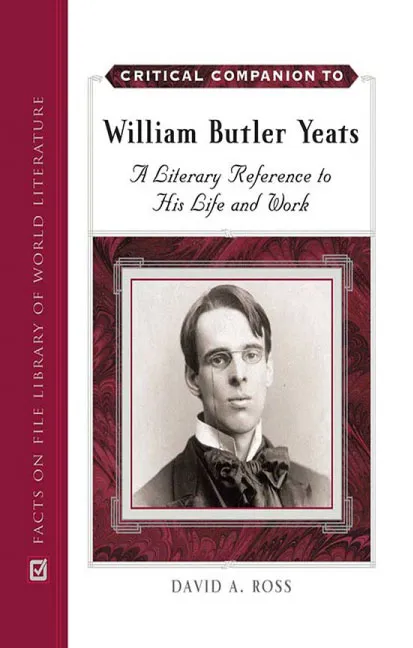
William Butler Yeats by David A. Ross
0.00 ৳
0.00 ৳
David A. Ross’s "Critical Companion to William Butler Yeats: A Literary Reference to His Life and Work" (2009) is an indispensable encyclopedic resource for anyone looking to navigate the complex, mystical, and deeply political world of Ireland’s greatest poet.
Yeats is notoriously difficult because his work evolved through so many stages—from "Celtic Twilight" Romanticism to harsh Modernism and personal occultism. Ross’s companion acts as a map to these shifts.
The book is designed for both the casual reader and the serious scholar, broken into four primary sections:
Biography: A detailed chronology of Yeats’s life, focusing on his unrequited love for Maud Gonne, his involvement in the Irish Abbey Theatre, and his eventual role as a Senator of the Irish Free State.
A-to-Z Entries: The "meat" of the book. It contains entries on every major poem (from "The Lake Isle of Innisfree" to "Byzantium"), every play, and his prose works like A Vision.
Key People and Places: Detailed profiles of the figures who shaped him, including Lady Gregory, Ezra Pound, and his wife Georgie Hyde-Lees.
Appendices: Includes a bibliography of his works and a guide to secondary research.
Ross helps the reader distinguish between the different "versions" of Yeats that appeared over his fifty-year career:
| Phase | Characteristics | Key Works |
| Early (Romantic) | Soft, dreamy, focused on Irish folklore and "The Celtic Twilight." | "The Stolen Child," "The Rose" |
| Middle (Political) | Sharper, more cynical, dealing with the Irish Revolution and the World War. | "Easter, 1916," "The Second Coming" |
| Late (Modernist) | Sparse, powerful, obsessed with old age, lust, and complex mystical symbols. | "Sailing to Byzantium," "Lapis Lazuli" |
One of Ross’s most helpful contributions is explaining Yeats’s "System." Yeats believed in a mystical collective memory called the Spiritus Mundi and a geometric view of history called Gyres.
The Gyre: Yeats visualized history as two interlocking cones or spirals. As one expands, the other contracts, marking the end of one 2,000-year era and the violent birth of the next.
The Mask: Ross explains Yeats's theory that a person must struggle to become their "anti-self" or "mask" to achieve true artistic greatness.
Clarity on Allusions: Yeats’s poetry is thick with references to Greek mythology, Irish legends, and 1920s politics. Ross provides the "decoder ring" for these references.
The Playwright Yeats: While many know him only as a poet, Ross gives significant space to Yeats’s Verse Dramas, explaining how his plays were essential to the Irish Literary Revival.
Objective Analysis: Ross balances admiration for Yeats’s linguistic genius with a critical look at his later, more controversial political leanings and his aristocratic elitism.
"Yeats did not just write about Ireland; he invented a version of Ireland through his words, blending the ancient heroic past with the brutal, changing present."