Why Nations Fail by Daron Acemoglu
0.00 ৳
0.00 ৳
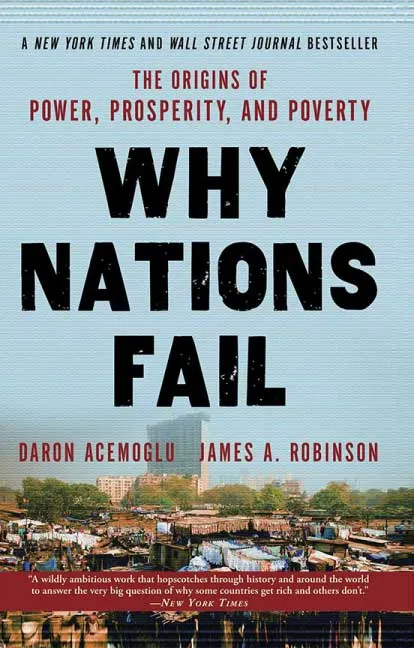
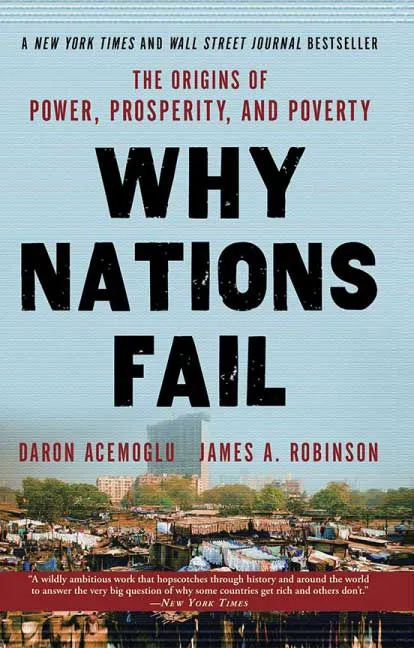
"Why Nations Fail: The Origins of Power, Prosperity, and Poverty" (2012) by Daron Acemoglu and James A. Robinson is a landmark work in modern economics and political science. It seeks to answer one of the oldest questions in history: Why are some nations rich and others poor?
The authors dismiss traditional theories—such as geography, culture, or "ignorant leaders"—and argue that the answer lies entirely in institutions.
The book’s core argument rests on a binary classification of the "rules" (institutions) that govern a society.
These allow and encourage participation by the great mass of people in economic activities.
Economic: Secure property rights, an unbiased law system, and a level playing field for new businesses.
Political: Power is spread broadly and subject to constraints (pluralism).
Result: These lead to innovation and sustainable growth because people have the incentive to invest and create.
These are designed to extract incomes and wealth from one subset of society to benefit a different subset (the elite).
Economic: High barriers to entry, lack of property rights for the masses, and state-sanctioned monopolies.
Political: Power is concentrated in the hands of a few with no checks and balances.
Result: These may see short-term growth (through state-led resource mobilization), but they eventually stall because they discourage "creative destruction."
Acemoglu and Robinson lean heavily on the concept of Creative Destruction (pioneered by Joseph Schumpeter).
New innovations replace old technologies, and new winners replace old losers.
The Conflict: Elites in extractive systems often block innovation because they fear it will destabilize their political power. This is why, according to the authors, the Industrial Revolution started in England and not in absolutist regimes like Austro-Hungary or Russia.
Why do some countries become inclusive while others stay extractive? The authors point to Critical Junctures—major historical events that disrupt the existing balance of power.
The Black Death: In Western Europe, the labor shortage empowered peasants to demand more rights (leading toward inclusivity). In Eastern Europe, landlords clamped down harder (leading to "second serfdom" and extraction).
The Atlantic Trade: In England, the profits from trade went to a broad class of merchants who challenged the Crown. In Spain, the Crown monopolized trade, strengthening the monarchy's extractive grip.
The book opens with a famous comparison of Nogales, Arizona and Nogales, Sonora.
The two cities share the same geography, the same climate, and the same cultural ancestry.
The Difference: One is on the U.S. side (inclusive institutions) and the other is on the Mexican side (historically extractive colonial roots). The difference in their prosperity is entirely due to the legal and political systems they live under.
The authors spend significant time debunking three popular myths:
The Geography Hypothesis: (e.g., Jared Diamond) The idea that tropical climates or lack of resources cause poverty.
The Culture Hypothesis: The idea that "Protestant work ethic" or "Confucian values" drive wealth.
The Ignorance Hypothesis: The idea that poor countries are poor because their leaders don't know how to fix the economy. (The authors argue leaders know what to do, but choose not to because it would hurt their own power).
| Concept | Description |
| Virtuous Circle | Inclusive political institutions lead to inclusive economic ones, which further entrench political rights. |
| Vicious Circle | Extractive political institutions lead to extractive economic ones, providing wealth to the elite to maintain their power. |
| Iron Law of Oligarchy | The tendency of new leaders in extractive systems to simply replace the old elite and continue the extraction. |
"Nations fail when they have extractive economic institutions, supported by extractive political institutions that impede and even block economic growth."