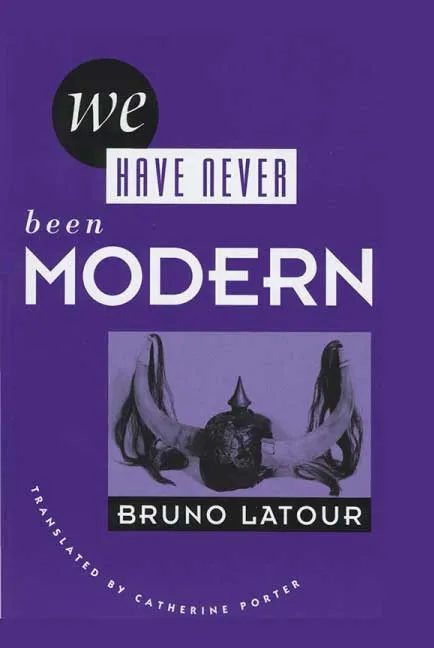
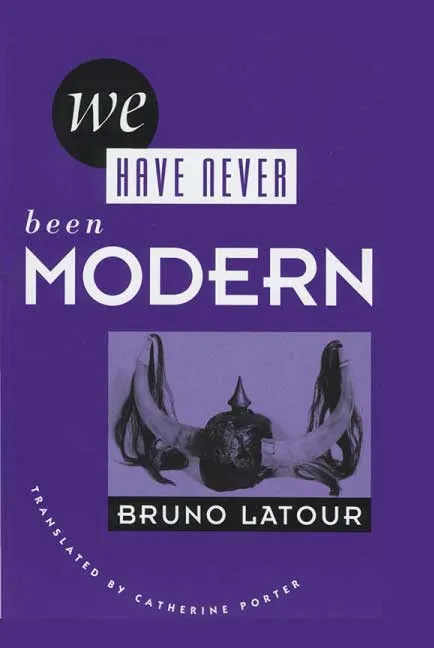
We Have Never Been Modern by Bruno Latour
0.00 ৳
0.00 ৳
Bruno Latour’s "We Have Never Been Modern" (1991) is a foundational text in the field of Science and Technology Studies (STS) and a radical re-evaluation of Western philosophy. Latour argues that the "Modern" project—the attempt to strictly separate the world of Nature (objects, science, facts) from the world of Culture (subjects, politics, values)—has never actually succeeded.
His central thesis is that while we claim to keep these spheres separate, our world is actually increasingly populated by "Hybrids" that belong to both.
Latour describes the "Modern Constitution" as a set of unwritten rules that define the Western worldview. It relies on two distinct practices:
Purification: The mental effort to keep "Nature" (which is objective and silent) separate from "Culture" (which is subjective and talkative).
Mediation (or Hybridization): The actual, physical practice of creating new things—like ozone holes, frozen embryos, or climate change—that are a mix of both nature and culture.
The Paradox: Latour argues that the more we pretend to purify the two spheres, the more hybrids we accidentally create. Because we refuse to acknowledge these hybrids as "real" entities, they proliferate out of control.
To Latour, being "Modern" isn't about technology or progress; it’s a specific way of treating time and history.
The Great Divide: Moderns believe they have broken away from the "primitive" past where people confused nature with spirits and politics.
The Illusion of Separation: We think we are unique because we have "pure" science and "pure" politics. Latour argues that "pre-modern" cultures were actually more honest because they openly acknowledged that their social lives and their natural environments were intertwined.
Latour points to contemporary issues to prove his point. Consider Climate Change:
Is it Nature? Yes, it involves CO2 molecules and atmospheric chemistry.
Is it Culture? Yes, it involves industrial policy, capitalism, and human behavior.
The Result: It is a "Hybrid." It cannot be understood solely through a lab or a parliament. We need a way to talk about these "Actor-Networks" where humans and non-humans interact.
| Concept | The "Modern" View | Latour’s "Non-Modern" View |
| Objects | Passive things to be studied. | "Actants" that have influence on the world. |
| Science | A discovery of pre-existing Truth. | A process of "construction" involving tools and people. |
| Politics | Only for human beings. | A "Parliament of Things" where nature is represented. |
| Time | A linear arrow toward progress. | A "spiral" where the past and present coexist. |
Because we have never actually been modern, Latour suggests we should stop trying. Instead of the "Modern Constitution," he proposes a "Parliament of Things."
This is a call to bring non-human "actors" (like the oceans, the forests, or viruses) into our political decision-making.
Instead of letting scientists speak for "Nature" and politicians speak for "People" in separate rooms, we must acknowledge that every issue is a messy mix of both.
Symmetry: Latour insists on "Generalized Symmetry," meaning we should use the same vocabulary to describe a scientist, a lab rat, and a vacuum pump.
Anthropology of the Moderns: He treats Western society not as the "pinnacle of reason," but as a tribe with its own strange rituals of "purification" that an anthropologist might study.
Impact: This book laid the groundwork for Actor-Network Theory (ANT), which has revolutionized how we study everything from sociology to the history of technology.
"We have never been modern. We have only been multiplying the number of hybrids while pretending they don't exist. To save the future, we must finally admit that our politics and our nature are one and the same."