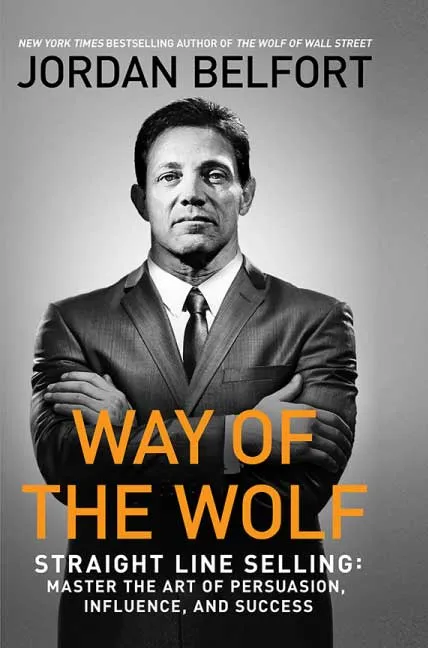
Way of the Wolf by Jordan Belfort
0.00 ৳
0.00 ৳
Jordan Belfort’s "Way of the Wolf: Straight Line Selling" (2017) is the definitive manual for the sales system that made him a legendary—and controversial—figure on Wall Street. While his memoirs (The Wolf of Wall Street) focused on his chaotic personal life, this book is a technical deep-dive into the Straight Line System, a psychological framework designed to move a prospect from "Hello" to "Yes" in the shortest time possible.
Belfort argues that every sale is the same, regardless of the product, and that success depends on controlling the "inner game" of your mind and the "outer game" of the conversation.
Belfort’s central metaphor is that a sale is a straight line.
The Goal: Start at point A (the open) and move to point B (the close).
The Boundaries: Above and below the line are the "boundaries." If the conversation drifts too far into "rapport-building" (shooting the breeze) or "technical tangents," you lose control.
The Siphoning Effect: Your job is to keep the prospect on the line. If they wander off, you must "siphon" them back toward the goal using specific tonal and linguistic shifts.
According to Belfort, a prospect will only buy if they are at a "10" (absolute certainty) on three specific scales:
The Product: They must believe the product is the best thing since sliced bread.
The Salesperson: They must trust and like you (and believe you are an expert).
The Company: They must trust the organization standing behind the product.
If the prospect is at a 5 or a 6 on any of these, they will give you an "objection" (e.g., "I need to think about it"). The Straight Line System is designed to systematically move all three scales to a 10.
Belfort argues that only 10% of communication is the actual words you say. The rest is how you sound and how you look.
The "Expert" Tone: You must sound "Scarcity-driven," "Utterly Sincere," and "A Person of Influence" within the first four seconds.
The "Whisper": Lowering your voice to share a "secret" creates instant intimacy and forces the prospect to lean in.
Body Language: He emphasizes "scanned" eye contact and a posture that suggests you are busy and successful, not desperate for a sale.
This is the "technical architecture" of the decision-making process:
Action Threshold: The level of certainty a person needs to say "yes." Some people have a low threshold (easy to sell), while others have a high threshold (hard to sell).
Lowering the Threshold: You can lower this by offering guarantees, social proof, or reducing the perceived risk.
The Pain Threshold: People buy to move away from pain. If you can identify a prospect's "pain point," you can use it to create urgency for the solution.
When a prospect gives you an objection like "I need to talk to my wife," Belfort teaches that this is rarely the true reason.
The Loop: Instead of arguing, you say, "I hear what you're saying, but let me ask you a question... does the idea make sense to you? Do you like the idea?"
The Pivot: This "loops" them back to the start of the line to build more certainty in the product (the first Ten) before addressing the specific objection again.
Belfort acknowledges his past and insists that the system must be used ethically.
The Rule of Qualification: Never sell something to someone who doesn't need it or can't afford it.
The "Straight Line" Moral: If you use these powerful psychological tools to hurt people, you aren't a salesperson—you're a predator.
"In every sale, the prospect is trying to sell you on why they can't buy. You are trying to sell them on why they should. The person who is more certain wins."