

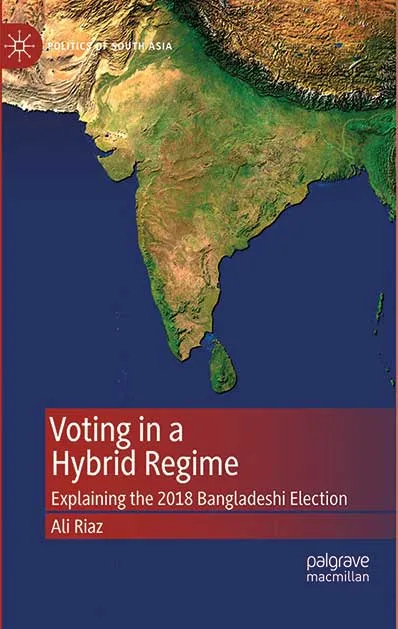
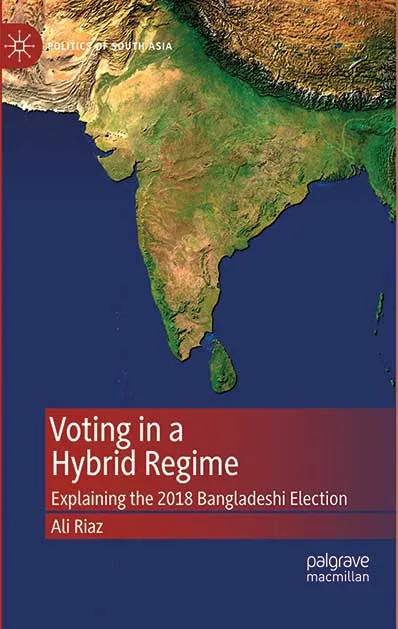
Voting in a Hybrid Regime by Ali Riaz
0.00 ৳
0.00 ৳
Ali Riaz’s "Voting in a Hybrid Regime: Explaining the 2018 Bangladeshi Election" (2019) is a rigorous political science analysis of how democratic institutions—specifically elections—are utilized by authoritarian-leaning governments to consolidate power.
Riaz, a distinguished professor and expert on South Asian politics, uses the 2018 Bangladeshi general election as a primary case study to illustrate the global trend of "Democratic Backsliding."
The core of Riaz’s architectural framework is the definition of a hybrid regime. This is not a "stalled democracy," but a distinct form of governance where:
Formal Democracy Exists: There are elections, a parliament, and a constitution.
Autocratic Substance Rules: In practice, the playing field is so heavily tilted in favor of the incumbent that the opposition has no realistic path to power.
The "Illiberal" Turn: Civil liberties, judicial independence, and media freedom are systematically eroded to ensure the regime's survival.
Riaz provides a "technical autopsy" of the December 30, 2018, election, where the ruling Grand Alliance won 288 out of 300 seats. He identifies several mechanisms used to achieve this result:
Legal Engineering: The use of laws (such as the Digital Security Act) to stifle dissent and monitor digital spaces.
State Character Change: The blurring of lines between the ruling party and state institutions (the bureaucracy, police, and election commission).
"Ghost Cases": The filing of thousands of criminal cases against opposition activists, many of whom were deceased or out of the country at the time of the alleged crimes, to prevent them from campaigning.
Riaz situates the Bangladeshi experience within a broader international context. He argues that what happened in 2018 was not an isolated incident but a blueprint for other hybrid regimes:
The Survival Strategy: Elections in these regimes are not meant to "choose" a leader, but to provide a veneer of international legitimacy.
Control of Information: He explores how the "architecture of fear" is built through surveillance and the selective application of the law.
The Role of the International Community: Riaz critiques the role of global powers who prioritize "stability" and "development" over democratic integrity, effectively giving a green light to hybridity.
| Theme | Riaz's Argument |
| Development vs. Democracy | The regime promotes a narrative that "too much democracy" hinders economic growth, forcing citizens to choose bread over freedom. |
| Institutional Capture | The election was not "stolen" on one day; it was won through the gradual takeover of every state institution over a decade. |
| The Disappearing Opposition | By criminalizing political dissent, the regime essentially removed the possibility of a two-party system. |
As someone interested in the architecture of writing, you will find Riaz's style highly structured and data-driven:
Evidence-Based: He relies on domestic and international observer reports, media archives, and legal documents to build an undeniable case.
Theoretical Grounding: He masterfully connects local events to political theories of competitive authoritarianism (Levitsky and Way).
Predictive Value: The book serves as a warning that once a regime transitions to a hybrid state, the "pathway back" to democracy becomes increasingly narrow and difficult.
"The 2018 election was a watershed moment. It demonstrated that in a hybrid regime, the vote is transformed from a tool of empowerment for the citizen into a tool of validation for the ruler."