0.00 ৳
0.00 ৳
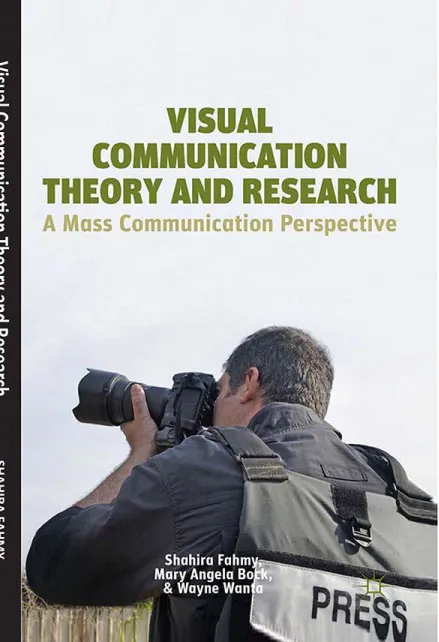
Visual Communication Theory and Research by Shahira Fahmy
Shahira Fahmy’s "Visual Communication Theory and Research" (2014), co-authored with Mary Angela Bock and Wayne Wanta, is a comprehensive academic cornerstone for understanding how images function in our digitally saturated world. It bridges the gap between classical communication theory and the modern challenges of a 24-hour, multi-platform visual news cycle.
As a researcher with deep roots in international journalism, Fahmy organizes the book to treat the "image" not as a decoration, but as a primary, powerful, and often manipulative unit of information.
1. The Core Framework: The "Visual Turn"
The book argues that we have moved past the "linguistic turn" into a "visual turn."
The Power of the Image: Fahmy posits that visuals are processed faster than text and are more likely to trigger emotional responses (affective processing) that bypass logical reasoning.
The Cognitive Bias: Because "seeing is believing," the book explores how audiences are less likely to question the authenticity of a photo than they are a written claim, making visual propaganda particularly dangerous.
2. Theoretical Pillars
Fahmy and her colleagues synthesize several key theories to explain visual impact:
Visual Agenda-Setting: Just as news editors tell us what to think about by selecting stories, visual editors tell us how to feel by selecting specific angles, crops, and subjects.
Visual Framing: The "frame" of an image (what is included vs. what is excluded) creates a narrative. For example, a tight crop on a protester's face creates an individual struggle, while a wide shot of a crowd creates a "mob" narrative.
Iconicity: The book investigates how certain images become "icons"—universal symbols that represent complex historical events (e.g., the "Falling Man" or the "Tank Man" of Tiananmen Square).
3. Key Research Methodologies
For those interested in the technical architecture of research, Fahmy provides a "toolbox" for analyzing visual data:
Visual Content Analysis: A quantitative approach where researchers count and categorize visual elements (e.g., gender of subjects, presence of weapons) to find broad patterns.
Semiotics: The study of signs and symbols. Fahmy explores how "denotation" (what is literally in the photo) differs from "connotation" (the cultural meaning we attach to it).
Visual Rhetoric: Analyzing images as arguments. How does a specific composition "persuade" the viewer to adopt a certain viewpoint?
4. Special Focus: Conflict and Global Journalism
A significant portion of Fahmy's work centers on the depiction of war and the "Other."
The "War on Terror": She analyzes how visual tropes were used to dehumanize certain populations and justify military intervention.
Citizen Journalism: The book addresses the shift from professional photojournalism to the "democratized" but unverified stream of images from social media (e.g., the Arab Spring or the Syrian Conflict).
5. Summary of Analytical Perspectives
| Perspective | Focus Area | Goal |
| Cognitive | How the brain processes light/shapes. | Understanding visual attention and memory. |
| Ethical | Digital manipulation and "Photoshop." | Maintaining the integrity of the "Visual Truth." |
| Sociological | How images reflect/enforce social norms. | Identifying biases in race, gender, and class. |
| Political | Images as tools of state power. | Analyzing propaganda and public diplomacy. |
6. Why It Matters for Writers and Creators
As someone interested in the architecture of writing, you may find Fahmy’s insights on "Visual Syntax" useful.
Just as a sentence has a structure (subject-verb-object), an image has a syntax of placement and gaze.
Understanding these "rules" allows a creator to intentionally lead a reader's eye and control the emotional "pacing" of a story, even in a text-based medium.
A Sharp Takeaway
"An image is never just a window; it is always a choice. By understanding the theory behind that choice, we move from being passive consumers to active, critical viewers."