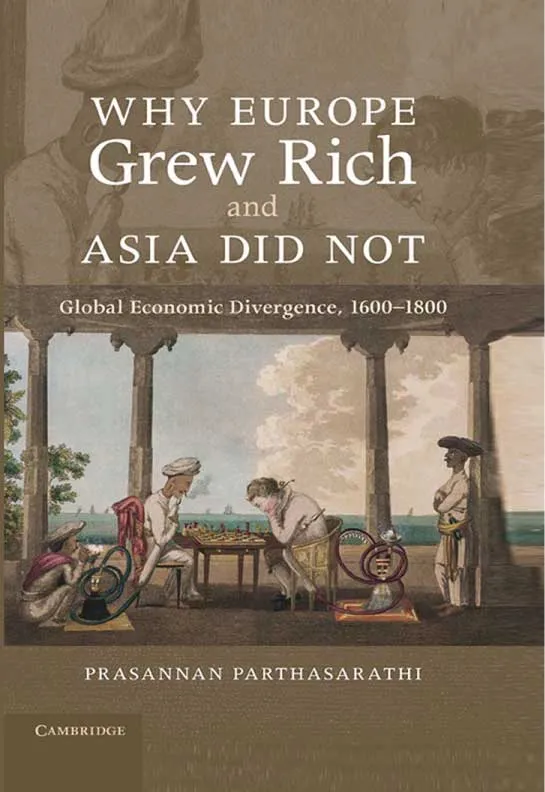
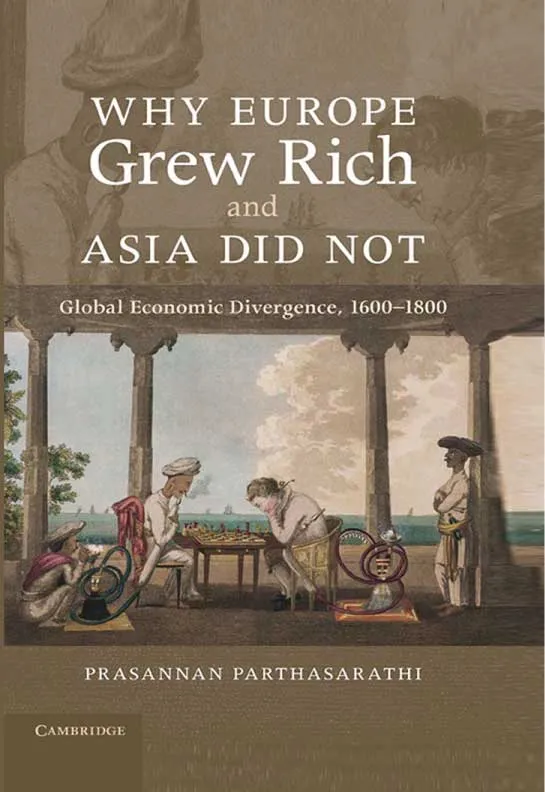
Why Europe Grew Rich and Asia Did Not by Prasannan Parthasarathi
0,00 ৳
0,00 ৳
Prasannan Parthasarathi’s "Why Europe Grew Rich and Asia Did Not: Global Economic Divergence, 1600–1850" (2011) is a powerful "revisionist" history that challenges the Eurocentric view of the Great Divergence.
While many historians (like Acemoglu or Landes) argue that Europe’s rise was due to superior internal institutions or culture, Parthasarathi argues that the paths of Britain and India were shaped by global competition and specific ecological pressures.
Parthasarathi’s most famous claim is that the Indian cotton textile industry was the primary driver of the British Industrial Revolution.
Competitive Pressure: In the 17th and 18th centuries, Indian calicoes and muslins were the highest quality and lowest cost in the world. British manufacturers couldn't compete on a level playing field.
State Protectionism: Britain didn't grow rich through "free markets." Instead, the British state used aggressive protectionism (the Calico Acts) to ban Indian imports, giving their own infant industry the space to grow and eventually automate.
The book identifies two specific problems that Britain faced in the 18th century that India did not. Ironically, solving these problems led to the Industrial Revolution:
Wood/Energy Shortage: Britain ran out of timber for fuel. This forced them to dig for coal, which led to the invention of the steam engine to pump water out of mines.
Competitive Pressure: The need to produce cotton textiles as cheaply as India led to the invention of spinning and weaving machinery.
In contrast, 18th-century India (particularly Bengal and South India) had plenty of wood, an efficient agricultural system, and a highly skilled, low-cost labor force. Because India didn't have these "problems," it had no immediate pressure to invent steam engines or coal-based technologies.
The author challenges the famous theory by Robert Allen that Britain industrialized because its wages were "high" and India’s were "low."
Parthasarathi provides evidence that Indian weavers actually had a high standard of living and significant bargaining power in the 18th century.
He argues that the "poverty" of India was not the cause of its failure to industrialize, but the result of British colonial policies that systematically dismantled the Indian economy.
The book highlights a crucial difference in state behavior:
The British State: Actively supported its merchants, invested in naval power, and used tariffs to protect domestic industry.
The Indian States: (Like the Marathas or Mysore) While sophisticated, they were often fighting for survival against British expansion. Once the East India Company took control, it transformed India from a manufacturing powerhouse into a supplier of raw materials (like raw cotton and opium).
| Feature | Great Britain | South Asia (India) |
| Main Textile | Wool (initially), then Cotton | Cotton (Global Leader) |
| Energy Source | Shifted to Coal (due to scarcity) | Relied on Wood/Biomass (abundant) |
| Economic Policy | Aggressive Protectionism | Generally Open/Internal Trade |
| Political Shift | Centralized, Pro-Business State | Fragmentation/Colonial Conquest |
Global Perspective: It treats the world as an interconnected system rather than looking at Europe in a vacuum.
Environmental History: It shows how "ecological accidents" (like where coal deposits are located) can change the course of history.
Institutional Critique: It argues that "science and reason" were not exclusive to Europe; rather, the application of technology was dictated by economic necessity.
"Europe did not grow rich because of an inherent cultural superiority, but because it was forced to innovate to escape an ecological and competitive trap created by the success of Asian manufacturing."