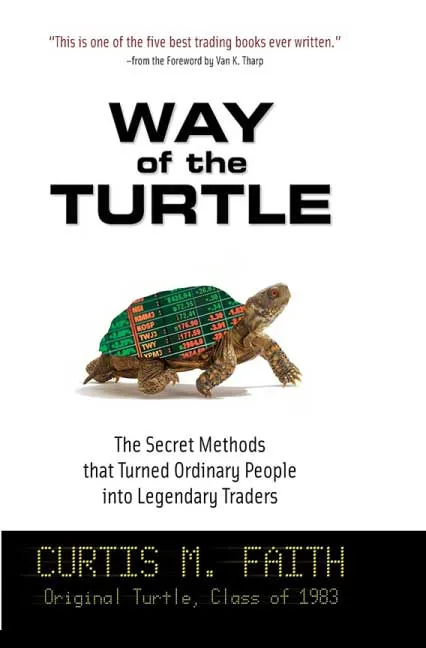
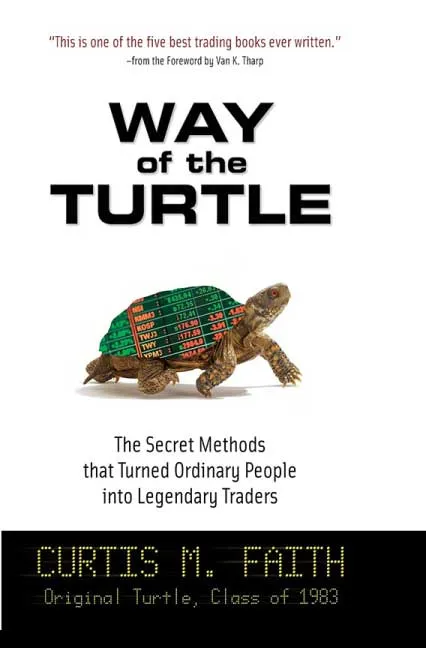
Way of the Turtle by Curtts M. Fatth
0,00 ৳
0,00 ৳
Curtis Faith’s "Way of the Turtle" (2007) is a seminal work in the world of systematic trading. It tells the inside story of one of the most famous experiments in financial history: the 1983 bet between legendary traders Richard Dennis and William Eckhardt.
Dennis believed that trading could be taught; Eckhardt believed it was an innate "genetic" talent. They recruited a group of novices—nicknamed "The Turtles"—gave them a set of rules and a million dollars each, and watched them earn over $175 million in just a few years. Curtis Faith was the most successful of those original Turtles.
The "Turtle Way" is built on the absolute rejection of "gut feelings."
Mechanical Trading: A trader should be like a machine. If the market hits a certain price, you buy; if it hits another, you sell. There is no room for ego or "hoping" a stock goes back up.
Trend Following: The Turtles didn't try to predict when a trend would start. They simply waited for a trend to reveal itself and then rode it until it ended.
The "Edge": Faith explains that a trading "edge" is simply a statistical advantage that plays out over hundreds of trades. Like a casino, you might lose a single hand, but the math ensures you win over time.
To trade like a Turtle, Faith argues you must answer these five questions with 100% clarity before every trade:
What Markets to Buy/Sell: Focus on liquid markets (Gold, Oil, S&P 500) where you can enter and exit easily.
Position Sizing: How much to buy? This is the most technical and important part of the book.
Entries: When to get in? (Usually based on "breakouts"—when a price hits a 20-day or 55-day high).
Stops: When to get out of a losing trade? (To protect your capital).
Exits: When to get out of a winning trade? (To lock in profits).
Faith spends a significant portion of the book on Risk Management, which he identifies as the real secret to the Turtles' success.
The Volatility Constant ($N$): The Turtles used a measure called $N$ (based on the Average True Range) to determine how much a market moved daily.
Equalizing Risk: They didn't buy "100 shares" of everything. Instead, they adjusted their position size so that every trade had the same "risk-dollar" impact on their account. If a market was volatile, they bought less; if it was stable, they bought more.
Why did some Turtles fail while Curtis Faith succeeded using the exact same rules?
The "I Know Better" Trap: Many traders started second-guessing the system when they hit a losing streak.
Drawdowns: Faith describes the "agony" of losing 20-30% of your account while waiting for the next big trend. Most people quit right before the system starts making money again.
Emotional Detachment: To be a Turtle, you must be comfortable with being "wrong" 60% of the time, knowing that the 40% of trades that win will be massive enough to cover all losses.
| Feature | The Turtle Way | The Amateur Way |
| Market View | Price is everything. | News, tips, and "feelings." |
| Risk | Fixed % of total capital per trade. | Random or "all-in" bets. |
| Patience | Waits for a confirmed breakout. | Tries to "buy the bottom." |
| Losses | Cut immediately at a pre-set "Stop." | Held onto in hopes of a "bounce." |
Since you appreciate the architecture of writing and technical guides, you’ll find Faith’s structure very logical:
He begins with the History (The Bet).
He moves to Psychology (The Human Element).
He dives into The Math (The System).
He ends with Backtesting (How to prove a system works before using real money).
"The secret of the Turtles was not the secret entry signal. It was the discipline to follow the rules when everyone else was panicking. Having a 'Way' is useless if you don't have the stomach to walk it."