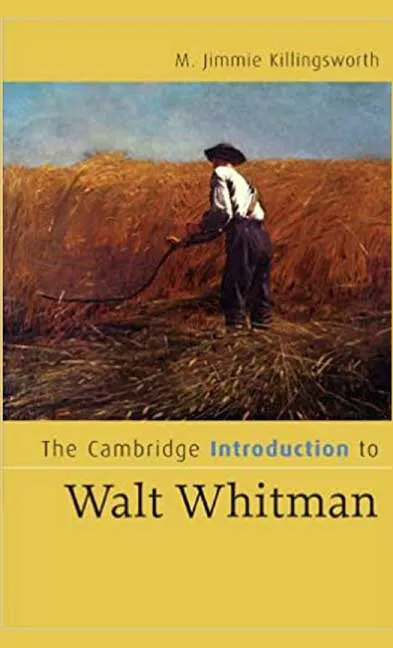
Walt Whitman by M. Jimmie Killingsworth
0,00 ৳
0,00 ৳
M. Jimmie Killingsworth’s "Walt Whitman: A Guide for the Perplexed" (2010) is a masterclass in literary architecture. Rather than a standard biography, Killingsworth provides a structural map of Whitman’s evolving masterpiece, Leaves of Grass, helping readers navigate the poet’s transition from a local journalist to the "prophet of American democracy."
Killingsworth addresses the "perplexity" of Whitman: how one man could be simultaneously earthy and divine, intensely private and aggressively public, a lover of individuals and a singer of the masses.
Killingsworth emphasizes that Leaves of Grass was not a single book, but a life-long project that Whitman revised and expanded through nine distinct editions (from 1855 to the "Deathbed Edition" of 1892).
The organic metaphor: Killingsworth explores how Whitman viewed his book as a living organism—growing, shedding, and regenerating like the grass itself.
The 1855 Breakthrough: The guide breaks down the shock of the first edition, which lacked a publisher’s name and used a revolutionary "free verse" style that abandoned traditional rhyme and meter.
A major portion of the book is dedicated to Whitman’s "Physiological" poetry. Killingsworth argues that for Whitman, the body was the entry point to the soul.
Democratizing the Anatomy: Whitman famously wrote, "The scent of these arm-pits aroma finer than prayer." Killingsworth explains how this was a radical political act: if every part of every human body is sacred, then slavery and social hierarchy become ontologically impossible.
Calamus vs. Children of Adam: The guide navigates the tension between Whitman’s poems of "Amative" love (man and woman) and "Adhesive" love (man and man), viewing them as twin pillars of a new American social glue.
Killingsworth tackles the "I" in Whitman’s poetry. He clarifies that when Whitman says "I," he is rarely talking about Walter Whitman the man; he is talking about a "Cosmic I" that contains all Americans.
The Cataloging Technique: Killingsworth analyzes Whitman’s famous lists (catalogs) of workers, tools, and landscapes. These aren't just lists; they are architectural "scaffolding" intended to make the reader feel the vastness of the nation.
The Reader as Partner: Whitman frequently addresses the reader ("What I assume you shall assume"). Killingsworth argues this creates a "transactional" poetry where the reader must finish the poem in their own life.
The book provides a technical look at how the trauma of the American Civil War shifted Whitman's writing style.
From Prophet to Nurse: Killingsworth traces the transition from the boisterous optimism of the 1850s to the somber, elegiac tones of Drum-Taps.
The Lincoln Myth: He analyzes how Whitman used the death of Abraham Lincoln in "When Lilacs Last in the Dooryard Bloom’d" to create a national ritual of mourning that could reunite a shattered country.
| Concept | Killingsworth's Interpretation |
| Free Verse | Not "lawless," but a new law based on the rhythm of the ocean and human breath. |
| Democracy | Not a political system, but a "way of seeing" other people as equals. |
| The City | New York (Mannahatta) as the "greatest poem," a place of endless, overlapping human stories. |
| Nature | A source of perpetual renewal that proves death is just a transition. |
As someone interested in the technical craft of writing, you will find Killingsworth’s focus on Whitman’s revisions particularly insightful.
He shows how Whitman would cut, paste, and retitle poems over decades to change their meaning.
He explores Whitman’s background in print journalism, showing how his knowledge of typesetting and "the physical page" influenced the long, sweeping lines of his poetry.
"Whitman did not want to be studied; he wanted to be absorbed. Killingsworth’s guide shows us that the 'perplexity' of Whitman is actually the complexity of being a modern human in a democratic society."