Vocabulary 4000 by Jeff Kolby
0,00 ৳
0,00 ৳
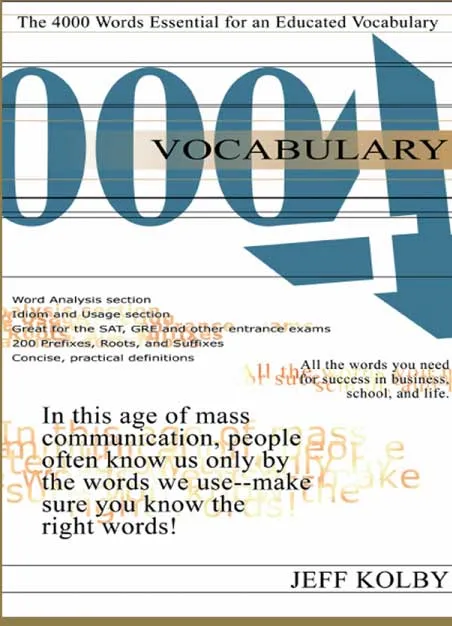
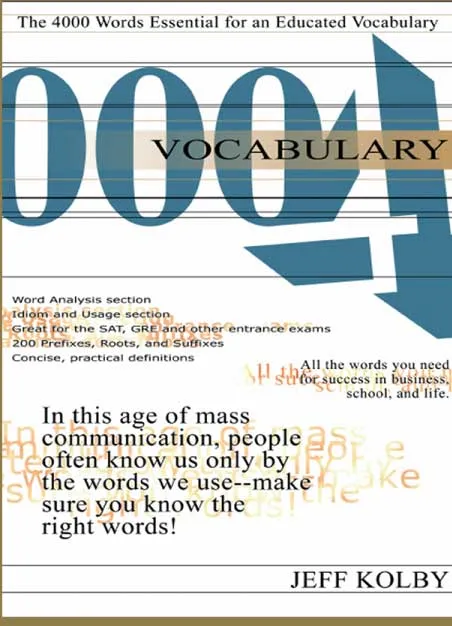
Jeff Kolby’s "Vocabulary 4000" (published by Nova Press) is a high-efficiency tool designed for students and professionals preparing for standardized tests like the GRE, SAT, GMAT, and LSAT. Unlike a standard dictionary, its "architecture" is built around the concept of High-Frequency Utility, focusing on the words most likely to appear in academic and professional settings.
The book is structured to move beyond rote memorization, emphasizing the structural patterns of English—roots, prefixes, and suffixes—to help you "decode" unknown words.
Kolby’s selection process is based on a "tiered" approach to language:
The Core: Words that are common enough to be essential but complex enough to be tested (e.g., loquacious, ephemeral, cacophony).
The Academic Tier: Terms specific to the sciences, humanities, and social sciences that frequently appear in reading comprehension passages.
The Professional Tier: Business and legal terminology often found in advanced professional examinations.
Instead of a simple A-Z list, Kolby uses several "hooks" to ensure long-term retention:
Word Roots (The DNA of Language): A significant portion of the book focuses on Latin and Greek roots (e.g., anthrop-, chron-, dict-). If you know the root, you can often guess the meaning of dozens of related words.
Word Groups (Synonym Clusters): The book groups words by their common themes. For example, instead of learning taciturn in isolation, you learn it alongside laconic and reticent under the "Quiet/Silent" category.
Contextual Sentences: Every word is provided with a sentence that illustrates its typical usage, helping the reader understand the "flavor" or nuance of the word (e.g., is it formal, sarcastic, or technical?).
Because Kolby is an expert in standardized testing (also known for his GRE Math Prep Course), the book includes specific technical features for exam-takers:
The Frequency List: It highlights the "top 400" words—the "must-knows" that appear with statistical regularity in SAT/GRE exams.
Common Pitfalls: It clarifies "confusables" (e.g., affect vs. effect, compliment vs. complement) that are frequently used as "distractor" answers in multiple-choice tests.
Suffix Analysis: It teaches how a word's part of speech changes with its ending, which is vital for sentence equivalence and completion tasks.
| Module | Focus | Benefit |
| Prefixes/Suffixes | The "Ends" of words. | Helps identify if a word is a verb, noun, or adjective instantly. |
| Greek/Latin Roots | The "Core" meaning. | Provides a "decoder ring" for 50% of the English vocabulary. |
| Word Lists | Categorized A-Z. | Traditional reinforcement for building a massive mental database. |
| Practice Exercises | Application. | Moves the word from "passive" recognition to "active" usage. |
As someone who appreciates the architecture of writing, you will likely value the book’s efficiency. It treats vocabulary as a system to be mastered rather than a list to be memorized.
The Logic of Etymology: By understanding the history of a word, the definition feels earned rather than arbitrary.
Spatial Organization: The layout is designed for "skimming and drilling," with clear headings and bolded keywords that allow for rapid-fire review sessions.
"A large vocabulary is not about sounding 'smart'; it is about having a higher resolution for your thoughts. The more words you have, the more precisely you can describe the world."